Which URL should be the pillar page of an SEO topic cluster when an article and a sales page target the same keyword? Choose the URL that answers the broadest question and helps readers find more specific content.
At iEducação, the guide to individual student report templates fills that role. The sales page serves a different purpose. It helps readers compare editable kits and decide whether to buy.
The audit identified 14 articles and one sales page at the core of the topic. The case shows how to use search intent, internal links, and Search Console to decide what each URL should do before rewriting or consolidating pages.
Table of contents
1. How the cluster was audited
The read-only WordPress inventory covered 422 published articles and 26 published pages. The review examined titles, saved content, links, and Rank Math focus keywords, including Portuguese variants such as “relatório descritivo” and “parecer descritivo” (both terms for descriptive reports).
The exact phrase appeared in the saved body of 40 articles, including in sales calls to action and link lists. To qualify for the core cluster, a page had to help readers write, adapt, or buy student reports.
The review then compared in-content links with links in the navigation, footer, and comments. All 15 core URLs returned HTTP 200 and declared themselves canonical in the HTML reviewed.
Two draft article URLs redirected to the guide with a 301 and were excluded from the core cluster. A declared canonical signals a preference. Use URL Inspection to see which URL Google selected.
2. Why the guide is the pillar page
A pillar page gives readers an overview of the topic and helps them find the specific answer they need. The iEducação guide explains what an individual student report is, offers examples from early childhood education, the early elementary grades, and special education, and shows readers how to write one.
All 13 supporting articles already linked to the guide from their main content. The sales page presents the kits and takes shoppers to checkout.
| URL and proposed role | Clicks | Impressions |
|---|---|---|
| Individual student report guide (editorial pillar) | 701 | 52,371 |
| Early childhood descriptive report (entry point for this level) | 924 | 53,179 |
| Editable report kits (sales destination) | 3 | 184 |
The Search Console data cover Web search from 08/04/2026 through 11/03/2026. These are totals by URL across the queries recorded in that period, as reported in the audit. The descriptive report received more clicks than the guide and covers a narrower task: writing reports for early childhood education. That reach supports giving this branch a prominent place in the cluster.
Does sharing a focus keyword mean the pages are cannibalizing each other?
The overlap is a reason to investigate. The guide and the sales page both listed “relatório individual do aluno” (individual student report) as their primary focus keyword in Rank Math. The first-grade article used it as a secondary keyword. Rank Math uses this field for its own analysis. Search Console shows which queries surfaced each page.
The exact query generated 6 clicks and 612 impressions across the property in the same period. The page and query exports were separate, so those totals cannot be split between the guide and the sales page.
To check for competition, filter the query in Search Console, open the Pages tab, and track which URLs appear over time. Then compare what each page helps readers do. Two pages can appear for the same query and meet different needs.
3. The cluster map assigns one task to each page
The central guide brings the steps together. Four groups organize the 13 supporting articles. Readers can reach the sales page when they are ready to compare kits.
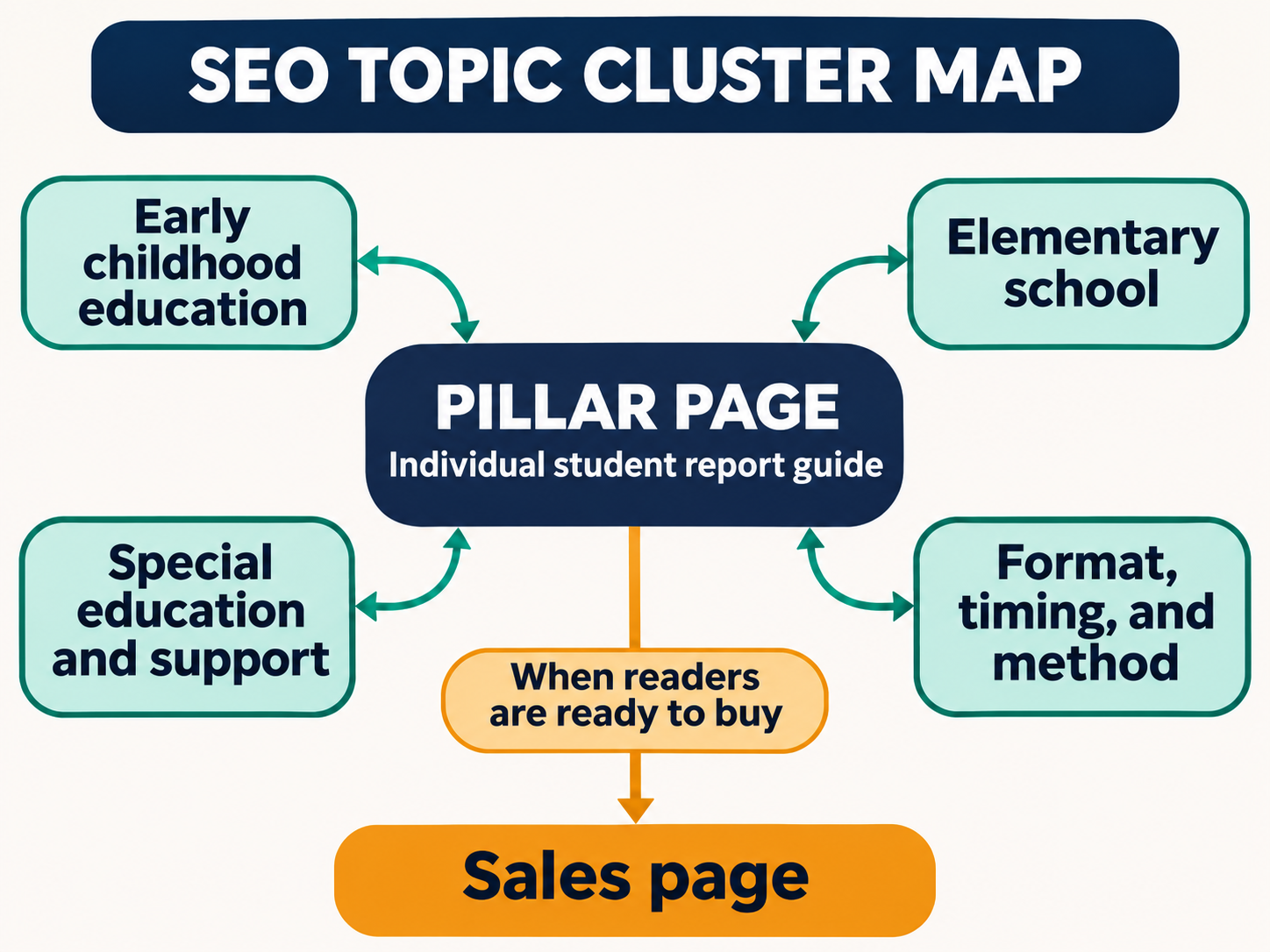
Early childhood education: Writing, adapting, and choosing by class
- Early childhood descriptive report. Learn how to write a narrative assessment.
- Individual report templates. Adapt descriptive and conceptual examples.
- Descriptive reports. Find language to describe progress, challenges, and next steps.
- Reports by class and term. Find examples for infant, toddler, and preschool groups and by two-month grading period.
Elementary school: Finding examples by grade
The first-, second-, and third-grade articles cover situations and templates for each grade. At the time of the audit, grades 4 and 5 had no dedicated published articles. The proposal keeps those examples in the guide until a distinct reader task warrants new URLs.
Special education and support: Documenting observations and interventions
The special education article explains how to document development and support. The article on autism in early childhood education covers a more specific case. The report on learning difficulties could receive links from the grade-specific examples where they discuss observed challenges and interventions.
Format, timing, and method: Three next steps
The school reports in Word article helps readers adapt an editable file. Final school reports covers the end of a grading period or school year. Writing school reports with AI explains how to turn observations into a draft and review the text. The audit found missing paths from the guide to those three articles and to the article on learning difficulties.
4. Which internal links to change first
- Make sure the page delivers what it promises. In the audit, the guide’s SEO title mentioned a PDF, and the body showed image previews without a labeled file link. Check that a PDF is available before promising a download. Keep the offer for editable kits on the sales page.
- Fill four gaps in the guide’s links. In the relevant sections, link to the articles on learning difficulties, editing in Word, final reports, and writing with AI. Use anchor text that tells readers what they can do next, such as “adapt the report in Word.” Review the table of contents labels and destinations as well, preserving existing links where possible.
- Clarify the differences between similar pages. Start with the early childhood education articles. Each page should show right away whether readers will learn to write a report, see examples, find wording for sensitive situations, or choose a template by class and term.
- Present the offer after answering the reader’s question. After a first-grade example, “See editable kits for grades 1 through 5” helps readers compare options. A discreet link back to the guide helps visitors who reach the sales page before they are ready to buy.
Google recommends crawlable links and descriptive anchor text. Check that the link is present in the HTML and that its label tells readers where it leads. The surrounding text should make the relationship between the pages clear.
5. How to measure whether the structure helped
Export queries by page for the most closely related URLs: the guide and the Word article, plus the early childhood narrative assessment, template, and descriptive report articles. Compare equivalent 28-day windows and, where you have historical data, the same seasonal period. Record the date of each change and track whether the expected URL starts appearing for queries that match its purpose.
Measure three actions separately: organic clicks recorded in Search Console, outbound clicks to checkout, and confirmed purchases where attribution is available. The narrative assessment’s click volume helps prioritize the review. It gives no evidence of conversions. The baseline predates the proposed changes and cannot support a traffic or sales forecast.
Questions about SEO topic clusters
When should you use a canonical or a redirect?
A canonical helps indicate the preferred version among duplicate or very similar URLs. A permanent redirect makes sense when an equivalent URL has replaced the original. The guide and the sales page serve distinct purposes. The proposal keeps both URLs and their self-referencing canonicals.
What changes when search results include AI answers?
Readers who arrive via a short answer or an AI-generated summary should be able to find the definition, the decision, the source, and the date range. Use headings that anticipate real questions and keep evidence close to the conclusions. Google recommends following SEO fundamentals for AI features in Search. This structure makes the article easier to read. It provides no guarantee of placement, citations, or rankings.
Sources and scope
This case draws on a read-only audit of iEducação that included a WordPress inventory, checks of public pages, and Search Console exports. The proposed improvements are hypotheses. They were not implemented as part of this case. See also Rank Math’s focus keyword documentation and the Search Console guidance on analyzing queries and pages.
For more context, see the iEducação Search Console technical audit, which covers crawling, indexing, and how to validate fixes.
Want to review your site’s content architecture? Message me on WhatsApp.